FDA Alerts

Recent Alerts

Morbid: Burke & Hare, Edinburgh's Body-Selling Killers

Morbid: Burke & Hare, Edinburgh's Body-Selling Killers

Edinburgh's body-selling killers. Hear Morbid's Burke & Hare Part 1.

Casefile 59: Amy Lynn Bradley's Vanishing at Sea

Casefile 59: Amy Lynn Bradley's Vanishing at Sea

March 1998. A balcony, a cruise ship, and a 23-year-old no one saw leave. Hear Casefile Case 59.

MFM: Free Range Children, Zoot Suit Riots

MFM: Free Range Children, Zoot Suit Riots

LA, 1943: sailors hunted young men in zoot suits. MFM 233 goes there, plus a 1976 bus kidnapping.

Bad Vegan: A Celebrity Chef's Fraud Story

Bad Vegan: A Celebrity Chef's Fraud Story

A celebrity restaurateur, a whirlwind romance, and a fortune gone. Stream Netflix's Bad Vegan.

The Executioner's Song: Gary Gilmore's Final Days

The Executioner's Song: Gary Gilmore's Final Days

Two killings, one demand to be executed. Mailer's Pulitzer winner follows Gary Gilmore.

Emergency Message System
  • Crime Alerts
  • CDC Alerts
  • FDA Alerts
  • Get Alerts
  • True Crime
  • Recalls
  • Crime Alerts
  • CDC Alerts
  • FDA Alerts
  • Get Alerts
  • True Crime
  • Recalls

FDA: What to Know About Breast Pumps

Article Image

If you’re giving your baby breast milk, you probably know there can be times when a breast pump can come in handy.

Breast pumps are medical devices regulated by the U.S. Food and Drug Administration. They can be used to maintain or increase a woman’s milk supply, relieve engorged breasts and plugged milk ducts, or pull out flat or inverted nipples so a nursing baby can latch on more easily.

And there are important safety considerations if you use one.

What kinds of breast pumps are available?

A. Breast shield: Cone-shaped cup that fits over the nipple and surrounding area.

B. Milk container: Detachable container that fits below the breast shield and collects milk as it is pumped.

C. Pump: Creates the vacuum that expresses milk. The pump may be attached to the breast-shield or have plastic tubing to connect the pump to the breast shield.

Breast pumps include a breast shield that fits over the nipple, a pump that creates a vacuum to express (or pump) milk, and a detachable container for collecting milk.

Pumps can be manual or powered. Powered pumps can use batteries or a cord that plugs into an electrical outlet. Some pumps even have an adapter for use in the car. (Obviously not while you’re driving, however!)

Double pumps extract milk from both breasts at the same time, while single pumps extract milk from one breast. (Find food safety tips for babies, including breast milk storage tips, on the FDA’s website.)

Is it safe to rent or share a breast pump?

Renting or sharing these devices can be dangerous if pumps are not designed for multiple users.

Consumers should be aware of the hazards of renting or sharing a breast pump that is not designed for multiple users—even with family and friends. Contaminated breast pumps could cause you and your baby to develop an infection.

“Even if a used device looks really clean, potentially infectious particles may survive in the breast pump and/or its accessories for a surprisingly long time,” says Kelly Colden, M.D., M.P.H., an FDA obstetrician-gynecologist on the Center for Devices and Radiological Health Obstetrical and Reproductive Health Devices Team.

Key points:

  • Manual breast pumps are designed for one user only (single use) and should never be rented or shared for safety reasons.
  • Powered breast pumps that are designed for single users should never be rented or shared.
  • Sharing a breast pump may violate the manufacturer’s warranty, which means you may not be able to get help from the manufacturer if you have a problem with the pump.
  • The FDA does not recognize the term “hospital grade,” so this term doesn’t mean a pump is safe.

The bottom line for sharing breast pumps designed for single users? Don’t do it.

And if you rent or share from an authorized provider (such as a hospital, lactation consultant, or specialty medical supply store), do so only if the pump is designed for multiple users. And do so only if you have your own accessories kit to avoid contamination. The accessories kit typically includes the milk container, breast-shield, and tubing.

Multiple-user pumps are designed so that the breast milk can never touch the working parts of the pump that are shared. The only part of a multiple-user breast pump that you can safely share is the pump itself.

What kind of breast pump should you buy?

If you purchase a pump, consider your needs. For instance, if you’ll use the pump only at home, one that plugs into the wall may be fine. But if you’ll pump at work or otherwise away from home, you may want to consider a device that’s easy to carry and battery-powered.

Key points:

  • You should never buy a previously used or “pre-owned” pump designed for single users. That’s because these pumps sold secondhand also can expose you and your baby to contamination.
  • Buying a used pump may violate the manufacturer’s warranty.

If you’re not sure which pump or accessories to get, talk to a health care professional who has expertise in breastfeeding.

How should you clean a breast pump?

Contamination can happen even to your personal pump if it is not cleaned properly. Correct use and cleaning helps protect you and your baby.

The FDA recommends cleaning and disinfection between uses. You should read the manufacturer’s instructions for specific information on how to keep your pump clean.

In general, steps for cleaning include:

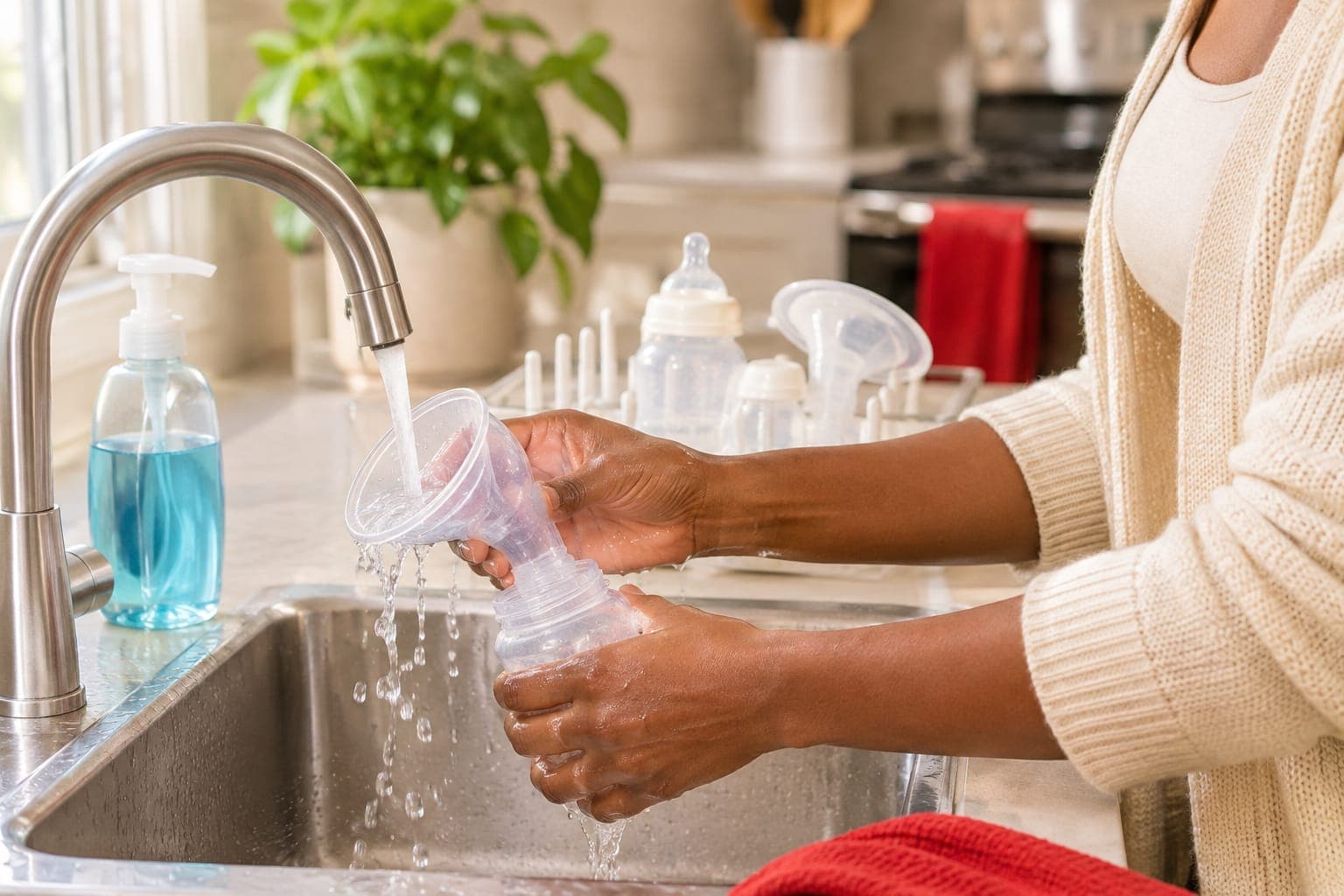
  • Rinsing each piece that comes into contact with breast milk in cool water as soon as possible after pumping;
  • Washing each piece separately using liquid dishwashing soap and plenty of warm water;
  • Rinsing each piece thoroughly with hot water for 10 to 15 seconds; and
  • Placing the pieces on a clean paper towel or in a clean drying rack and allowing them to air dry.

Wiping the pump body with ethanol or isopropyl alcohol at 70 to 90 percent concentration—or boiling the breast pump parts in water—generally is also acceptable. If the tubing looks moldy or cloudy, stop use and replace the tubing immediately.

If you’re renting or buying a multiple-user device, ask the person providing the pump to make sure all components (including internal tubing), have been cleaned and disinfected according to the manufacturer’s instructions.

How should breast milk be stored after expressing?

There are general guidelines for storing the milk you express. The U.S. Centers for Disease Control and Prevention and HHS Office of Women's Health have information on how to safely store and prepare expressed breast milk.

How can you report problems with breast pumps?

If a breast pump is not working as it should—for instance, if there are electrical problems or issues with suction—you can contact the manufacturer for recommendations on what to do with your device.

If you’re injured while using a breast pump or have pain, contact your health care provider. The FDA also encourages you to report injuries or problems with regulated devices to the agency. You can file a voluntary report by phone at 1-800-FDA-1088 or online at MedWatch, the FDA Safety Information and Adverse Event Reporting program.

Source:https://www.fda.gov/consumers/consumer-updates/what-know-when-buying-or-using-breast-pump

Share This Alert

OR SHARE

Past Alerts & News

FDA Alerts

18 November 2026

Post

FDA: Cyclospora

The FDA explains what Cyclospora is, who is at risk, the symptoms of cyclosporiasis, and steps consumers can take when handling fresh produce....
Read More

FDA Alerts

16 November 2026

Post

FDA: Medical Devices for Weight Loss

The FDA gives an overview of weight-loss and weight-management devices, their benefits and risks....
Read More

FDA Alerts

14 November 2026

Post

FDA: The Facts on Tampons and Tampon Safety

The FDA explains how tampons are regulated as medical devices, how to use them safely, and the warning signs of toxic shock syndrome....
Read More

FDA Alerts

12 November 2026

Post

FDA: FDA-Approved Devices

The FDA explains the types of approved heart devices, including AEDs, pacemakers, and stents, when to call 911, and how to report a device problem....
Read More

FDA Alerts

10 November 2026

Post

FDA: Traumatic Brain Injury

The FDA explains what traumatic brain injury is, its symptoms, how it is diagnosed, what the agency is doing about it......
Read More

FDA Alerts

08 November 2026

Post

FDA: Vaccination Is the Best Protection Against Measles

The FDA explains that approved measles vaccines are safe and effective, who is most at risk from measles.....
Read More

FDA Alerts

06 November 2026

Post

FDA: How to Properly Store E-Liquids

The FDA explains why e-liquids are dangerous for children and pets, how to store and handle them safely....
Read More

FDA Alerts

04 November 2026

Post

FDA: Know Your Treatment Options for COVID-19

The FDA explains COVID-19 treatment options, why talking to a health care professional right away matters...
Read More

FDA Alerts

02 November 2026

Post

FDA: It's a Good Time to Get Your Flu Vaccine

The FDA explains why getting a flu vaccine in the fall can lower your chances of getting the flu, and why a new vaccine is made every year....
Read More
Romorgniz Six-Drawer Dressers Sold On Amazon Recalled Over Child Tip-Over Risk

CDC Health Alerts

Consumer Product Recalls

CPSC

Crime Alerts

FDA Alerts

14 October 2026

Post

Romorgniz Six-Drawer Dressers Sold On Amazon Recalled Over Child Tip-Over Risk

Romorgniz is recalling about 12,078 Romorgniz Six-Drawer Dressers because they are unstable if they are not anchored to the wall and can tip over onto childr......
Read More
Snow Peak Takibi Propane Fireplace Inserts Recalled After Lava Rocks Explode

CDC Health Alerts

Consumer Product Recalls

CPSC

Crime Alerts

FDA Alerts

14 October 2026

Post

Snow Peak Takibi Propane Fireplace Inserts Recalled After Lava Rocks Explode

Snow Peak USA, Inc. of Portland, Oregon, is recalling its Snow Peak Takibi Fireplace Propane Inserts and Lava Rocks because the lava rocks can ignite and exp......
Read More
Boat Engines Produce Enough Carbon Monoxide to Kill in Minutes. Here Is Where It Builds Up.

CDC Health Alerts

Consumer Product Recalls

CPSC

Crime Alerts

FDA Alerts

14 October 2026

Post

Boat Engines Produce Enough Carbon Monoxide to Kill in Minutes. Here Is Where It Builds Up.

Carbon monoxide poisoning is one of the leading causes of boating-related deaths in the United States — and unlike CO hazards in a home, boat CO can accumula......
Read More
Your Pool Heater Could Be Filling Your Backyard with a Gas That Kills in Minutes

CDC Health Alerts

Consumer Product Recalls

CPSC

Crime Alerts

FDA Alerts

14 October 2026

Post

Your Pool Heater Could Be Filling Your Backyard with a Gas That Kills in Minutes

Gas-powered pool heaters produce carbon monoxide as a byproduct of combustion — and the U.S. Consumer Product Safety Commission (CPSC) warns that a malfuncti......
Read More
Holiday Decorations Cause Thousands of House Fires Every Year. Here Is What the CPSC Says to Stop Doing.

CDC Health Alerts

Consumer Product Recalls

CPSC

Crime Alerts

FDA Alerts

14 October 2026

Post

Holiday Decorations Cause Thousands of House Fires Every Year. Here Is What the CPSC Says to Stop Doing.

Every holiday season, Americans decorate their homes with lights, greenery, candles, and ornaments — and every holiday season, thousands of those homes catch......
Read More
The Garage Door Safety Test Most Homeowners Have Never Performed That Could Save a Child’s Life

CDC Health Alerts

Consumer Product Recalls

CPSC

Crime Alerts

FDA Alerts

14 October 2026

Post

The Garage Door Safety Test Most Homeowners Have Never Performed That Could Save a Child’s Life

Automatic garage doors are one of the largest moving mechanical objects in any American home — and the U.S. Consumer Product Safety Commission (CPSC) warns t......
Read More
Terms and ConditionsDo Not Sell or Share My Personal InformationPrivacy PolicyPrivacy NoticeAccessibility NoticeUnsubscribe
This website is an independent platform that provides information and services related to health, wellness, and safety. We rely on publicly available information to provide accurate and up-to-date information to our users. However, we are not affiliated with any government entity, and the information provided on this website is for general informational purposes only. We do not guarantee the accuracy, completeness, or usefulness of any information provided on this website. Any reliance you place on such information is strictly at your own risk. We are not responsible for any loss or damage arising from your use of this website or any information contained herein. Furthermore, the information provided on this website is not intended to be a substitute for professional medical advice, diagnosis, or treatment. Always seek the advice of a qualified healthcare provider with any questions you may have regarding a medical condition. Finally, any product or service mentioned on this website is not intended to diagnose, treat, cure, or prevent any disease.
Copyright © 2026 Emergency Message System