In a two-year study spanning from October 2010 through July 2012, the FDA Center for Veterinary Medicine (CVM) screened over 1,000 samples of pet food for bacteria that can cause foodborne illnesses.[1] (The illnesses are called “foodborne” because the bacteria are carried, or “borne,” in or on contaminated food.) The study showed that, compared to other types of pet food tested, raw pet food was more likely to be contaminated with disease-causing bacteria.
The Pet Food Study
Raw pet food was not included in the first year of the study. In the second year, CVM expanded the study to include 196 samples of commercially available raw dog and cat food. The center bought a variety of raw pet food online from different manufacturers and had the products shipped directly to six participating laboratories.[2] The raw pet food products were usually frozen in tube-like packages and made from ground meat or sausage.
The participating laboratories analyzed the raw pet food for harmful bacteria, including Salmonella and Listeria monocytogenes. In past projects, CVM had monitored dog and cat food for the presence of Salmonella. But before this study, the center “had not investigated the occurrence of Listeria in pet food,” said Renate Reimschuessel, a veterinarian at CVM’s Office of Research and one of the study’s principal investigators. Dr. Reimschuessel further noted that “quite a large percentage of the raw foods for pets we tested were positive for the pathogen Listeria monocytogenes.” (Pathogens are disease-causing germs, like some bacteria. Not all bacteria are harmful pathogens, though. Some bacteria are helpful to people and animals, such as those that live in the intestines and contribute to a healthy gut.)
Of the 196 raw pet food samples analyzed, 15 were positive for Salmonella and 32 were positive for L. monocytogenes (see Table 1).
| Type of Pet Food Sample | No. samples tested | No. positive for Salmonella | No. positive for L. monocytogenes |
|---|---|---|---|
| Raw pet food | 196 | 15 | 32 |
| Dry exotic pet food* | 190 | 0 | 0 |
| Jerky-type treats† | 190 | 0 | 0 |
| Semi-moist dog food‡ | 120 | 0 | 0 |
| Semi-moist cat food‡ | 120 | 0 | 0 |
| Dry dog food§ | 120 | 0 | 0 |
| Dry cat food§ | 120 | 1 | 0 |
| * Non-cat and non-dog food, such as dry pellets for hamsters, gerbils, rabbits, amphibians, and birds. † Included chicken jerky product, pig ears, and bully stick-type products. ‡ Typically packaged in pouches for retail sale, such as (1) pouched dog and cat food; and (2) food treats shaped like bacon, fish, pork chops, and burgers. § Included pellet- or kibble-type food typically packaged in bags for retail sale. Note: Canned pet food samples were not tested in this study. |
Based on the study’s results, CVM is concerned about the public health risk of raw pet food diets. As Dr. Reimschuessel explained, the study “identified a potential health risk for the pets eating the raw food, and for the owners handling the product.” Owners who feed their pet a raw diet may have a higher risk of getting infected with Salmonella and Listeria monocytogenes.
Tips to Prevent Foodborne Illness from Raw Pet Food
If you choose to feed raw pet food to your pet, be aware that you can infect yourself with Salmonella or L. monocytogenes by spreading the bacteria from the contaminated food to your mouth. For instance, you may accidentally ingest the bacteria if you touch your mouth while preparing the raw food or after handling a contaminated utensil. If you get Salmonella or L. monocytogenes on your hands or clothing, you can also spread the bacteria to other people, objects, and surfaces.
Here are some tips to prevent infection with Salmonella and L. monocytogenes:
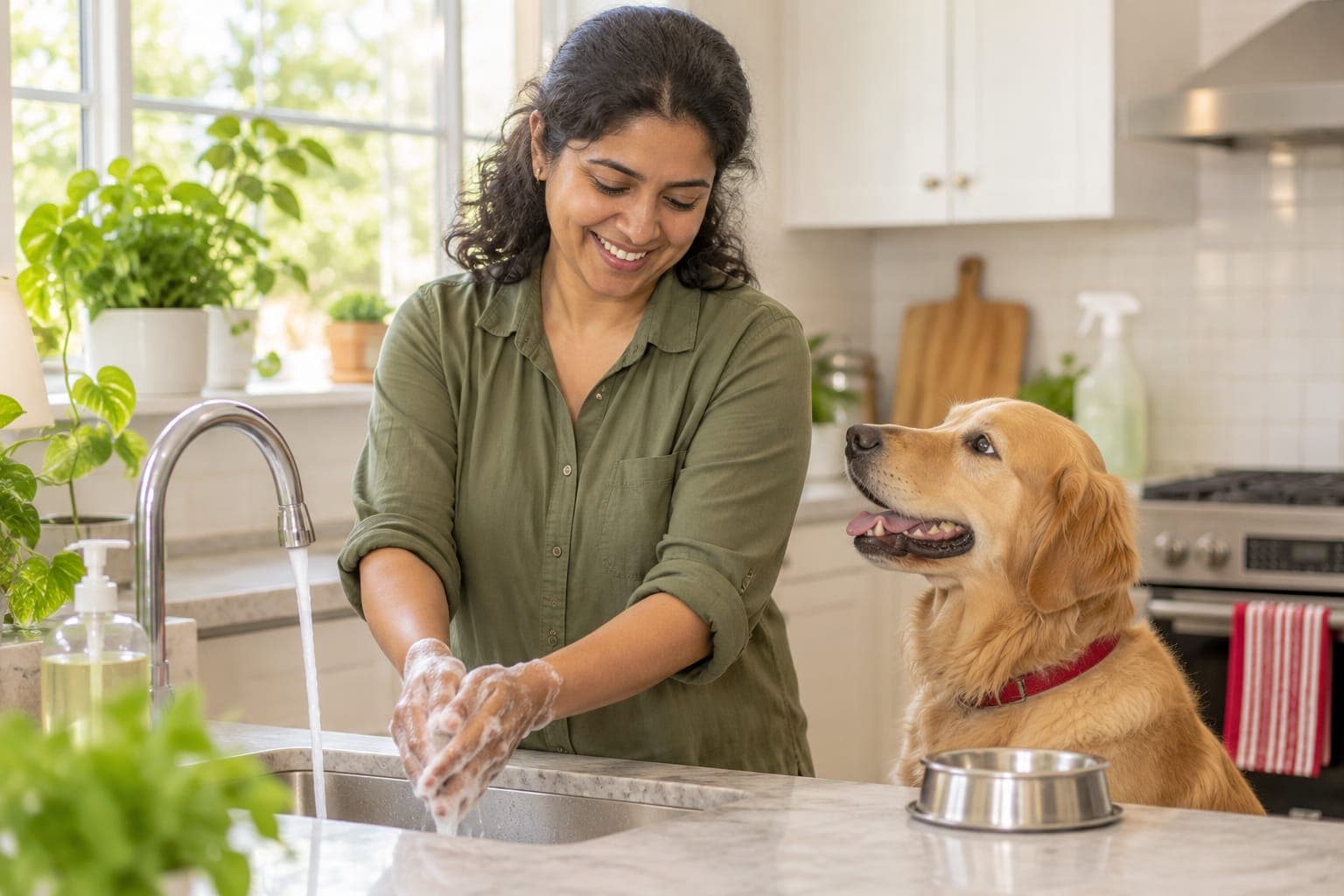
- Thoroughly wash your hands with soap and water (for at least 20 seconds) after handling raw pet food, and after touching surfaces or objects that have come in contact with the raw food. Potential contaminated surfaces include countertops and the inside of refrigerators and microwaves. Potential contaminated objects include kitchen utensils, feeding bowls, and cutting boards.
- Thoroughly clean and disinfect all surfaces and objects that come in contact with raw pet food. First wash with hot soapy water and then follow with a disinfectant. A solution of 1 tablespoon bleach to 1 quart (4 cups) water is an effective disinfectant. For a larger supply of the disinfectant solution, add ¼ cup bleach to 1 gallon (16 cups) water. You can also run items through the dishwasher after each use to clean and disinfect them.
The Difference between Cleaning and Disinfecting
Cleaning removes germs (like bacteria) and dirt from surfaces and objects. Cleaning works by using soap (or detergent) and water to physically remove germs and dirt. This process doesn’t necessarily kill germs, but by removing them, cleaning lowers the number of germs and the risk of spreading infection.
Disinfecting kills germs on surfaces and objects. Disinfecting works by using chemicals, such as bleach, to kill germs. This process doesn’t necessarily clean dirty surfaces and objects or remove germs, but by killing germs after cleaning, disinfecting can further lower the risk of spreading infection.
Source: How to Clean and Disinfect Schools to Help Slow the Spread of Flu – Centers for Disease Control and Prevention
- Freeze raw meat and poultry products until you are ready to use them, and thaw them in your refrigerator or microwave, not on your countertop or in your sink.
- Carefully handle raw and frozen meat and poultry products. Don’t rinse raw meat, poultry, fish, and seafood. Bacteria in the raw juices can splash and spread to other food and surfaces.
- Keep raw food separate from other food.
- Immediately cover and refrigerate what your pet doesn’t eat, or throw the leftovers out safely.
- If you’re using raw ingredients to make your own cooked pet food, be sure to cook all food to a proper internal temperature as measured by a food thermometer. Thorough cooking kills Salmonella, L. monocytogenes, and other harmful foodborne bacteria.
- Don’t kiss your pet around its mouth, and don’t let your pet lick your face. This is especially important after your pet has just finished eating raw food.
- Thoroughly wash your hands after touching or being licked by your pet. If your pet gives you a “kiss,” be sure to also wash your face.
No matter what type of pet food you feed your pet, you should always follow these safe handling instructions.
Pet Food Recalls
Both cooked and raw pet food products are recalled for various reasons, including for the presence of Salmonella and Listeria monocytogenes. For a list of recalled pet food and the reason for the recall, please see FDA’s Recalls & Withdrawals Web page.
1 Nemser S, Reimschuessel R. Food Emergency Response Network (FERN) Microbiology Cooperative Agreement Program (MCAP), FDA Center for Veterinary Medicine (CVM) Special Project: Pet food testing for selected microbial organisms. Final Report 2010-2012. The study was conducted by FDA CVM’s Veterinary Laboratory Investigation and Response Network (Vet-LIRN), in collaboration with FERN MCAP laboratories. The journal citation is Nemser S, Doran T, et al. Investigation of Listeria, Salmonella, and Toxigenic Escherichia coli in Various Pet Foods. Foodborne Pathog Dis 2014;11:706-709.
2 Florida Department of Agriculture and Consumer Services; Michigan Department of Agriculture; Minnesota Department of Agriculture; North Carolina Department of Agriculture; Ohio Department of Agriculture; and Washington Department of Agriculture.